

The Washington Post’s Gregory Schneider recently reported on the Shockoe Institute and Expanding Freedom.
In the article the Post features Lucy Mead, a woman born into slavery and sold multiple times after age 9. She was free for 30 years when she took out a newspaper ad in 1895 with a simple plea to find her people. Lucy’s story is featured in the Expanding Freedom exhibit.
Mr. Schneider’s story goes on to explain how organizations, such as the Shockoe Institute, are focused on bringing America’s darkest hour to light as a tribute to America’s struggle to attain its unique promise of greatness. Shockoe Institute President and CEO Marland Buckner shares in the article: “You better believe America’s an exceptional nation. Absolutely. The story of the struggle to expand human freedom is what makes us exceptional.”
When speaking about how our nation should honor the 250th anniversary of the Declaration of Independence, Buckner says that this is the perfect time to consider the nation’s progress in achieving Jefferson’s proclamation of the equality of all — and the context in which it was written. “We love, love, love to tell ourselves and the rest of the world how big and bad we are. Well, if we’re so big and bad, then let’s take a good, hard, long look in the mirror and let’s get tough-minded about fixing how we got to be where we are,” he said.
The article explains how the Shockoe Institute’s mission goes beyond history and is focused on using the lessons of our history to improve our civic life.
As part of writing the article, Mr. Schneider asked if Lucy Mead ever found her family. The Shockoe Institute historians in residence shared that it is not known whether she - or any of the others whose similar stories are collected at the institute - ever found them.
The Shockoe Institute welcomes you to visit Expanding Freedom to learn more.
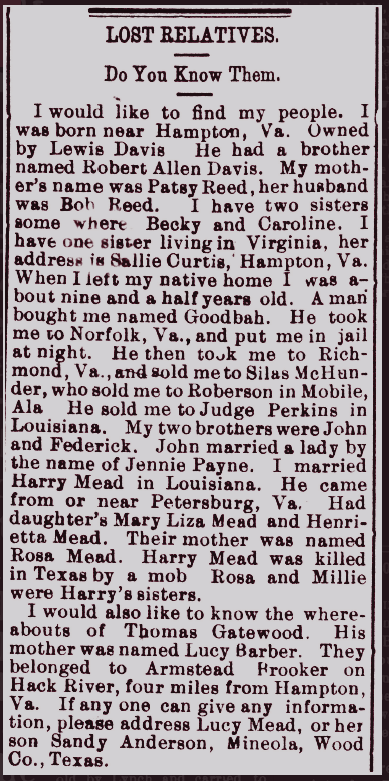
In 1895, Lucy Mead advertised her search for relatives in the Richmond Planet newspaper. She recounted being sold as well as the murder of her husband by a mob in Texas.
“Lost Relatives. Do You Know Them,” Richmond Planet, October 26, 1895