
“Witness tree what have you seen?...
Witness tree what can you share?...
Nature doesn’t take the blame…
We don’t have to move in shame…”
By Hampton D. Carey, a PhD in American history from Columbia University who specializes in slavery, Reconstruction, and early black leadership. Her dissertation, “New Voices in the Old Dominion, 1867-1902” focuses on the political activism of black Virginians during the period of their initial enfranchisement and their resistance to the ultimately successful movement to take away those rights and erase their progress.
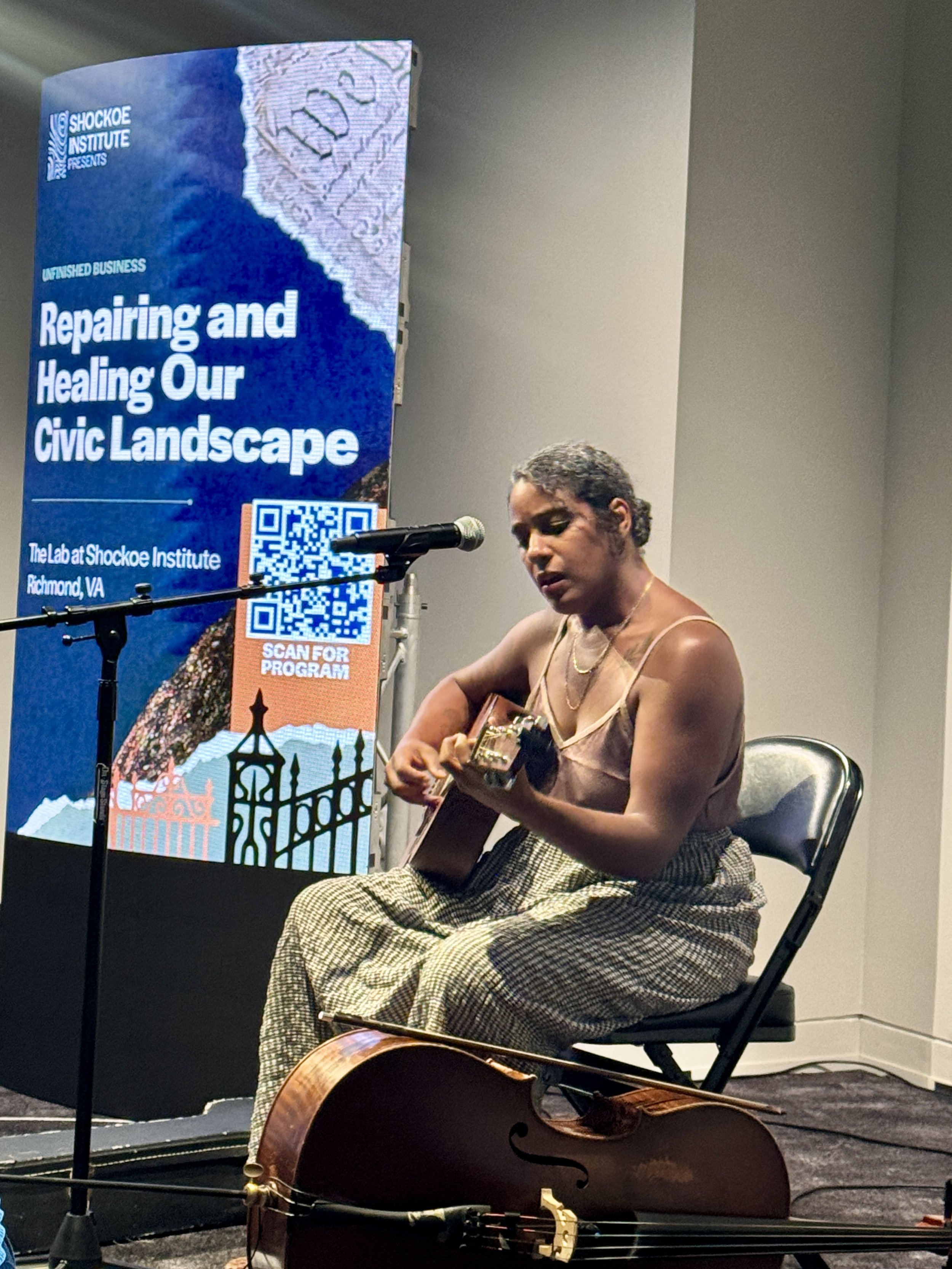
These are a few lines from Leyla McCalla‘s hauntingly beautiful song, “Witness Tree,” which stirs the imagination around what memories our landscape holds in the ongoing quest to uncover and name the past. Leyla sang the entire song at the Shockoe Institute on September 16th as part of a panel entitled “Repairing and Healing Our Civic Landscape,” the second event of the Institute’s Unfinished Business series. On the panel, Leyla, who is a Grammy Award-winning artist and the founding artistic director of the Shockoe Institute, was joined by Brian Palmer, a Peabody Award-winning journalist who has led efforts in Richmond to reclaim East End Cemetery, and Dr. Adam Rosenblatt, author of Cemetery Citizens: Reclaiming the Past and Working for Justice in American Burial Grounds and director of the Center for Human Rights at Duke University. Shockoe Institute President and CEO Marland Buckner moderated the event. I found it an incredibly inspirational evening, punctuated by evocative music and the passion of each of these individuals doing such important work to expand our history.
Any historian of American slavery and the African American past that followed it will tell you that the hardest part of the job is documenting the lives and giving voice to long dead, deliberately silenced people. That is why we so need artists—to conjure the ineffable and further pique our hearts and minds. This is largely because one of the greatest evils of slavery was and is the false narrative that was created to justify it and the extremely oppressive Jim Crow era that took its place. Most black lives and longings—all aspects of their existence, really—had been deeply buried or gravely misrepresented to serve the prevailing myths and maintain social and economic dominance. (That agenda marches on daily). Of course, many will be forever lost. But the work of reclaiming their lives, uncovering memories, and marking their importance forges on.
Both Brian and Adam are literally unearthing the past with their work restoring black cemeteries and salvaging the epitaphs of the inhabitants. One headstone at a time, they are unveiling how the deceased lived their lives and embraced their freedom after 1865.
Leadership in mutual aid societies—the Knights of Pythias, the Odd Fellows, the Independent Order of St. Luke, for instance—documents the proliferation of networks intended to build community and direction after emancipation. Reading the headstones, Adam said, “clearly shows how African Americans, who were denied everything, built a civil society from scratch.”
When Brian first came to the East End cemetery, he said he was shocked by the conditions, furious about the damage decades of Jim Crow policies had wrought. Initially, he said, “I wanted to document the wrong,” but that changed. His work moved from feeling obligatory into becoming more of a mission—an almost sacred privilege of consecrating the space and hearing the ancestors. “With each gravestone, we feel a victory and the incremental progress of doing something that really matters and the connection that comes with that. Reclaim the cemetery, reclaim the people, reclaim the love.”
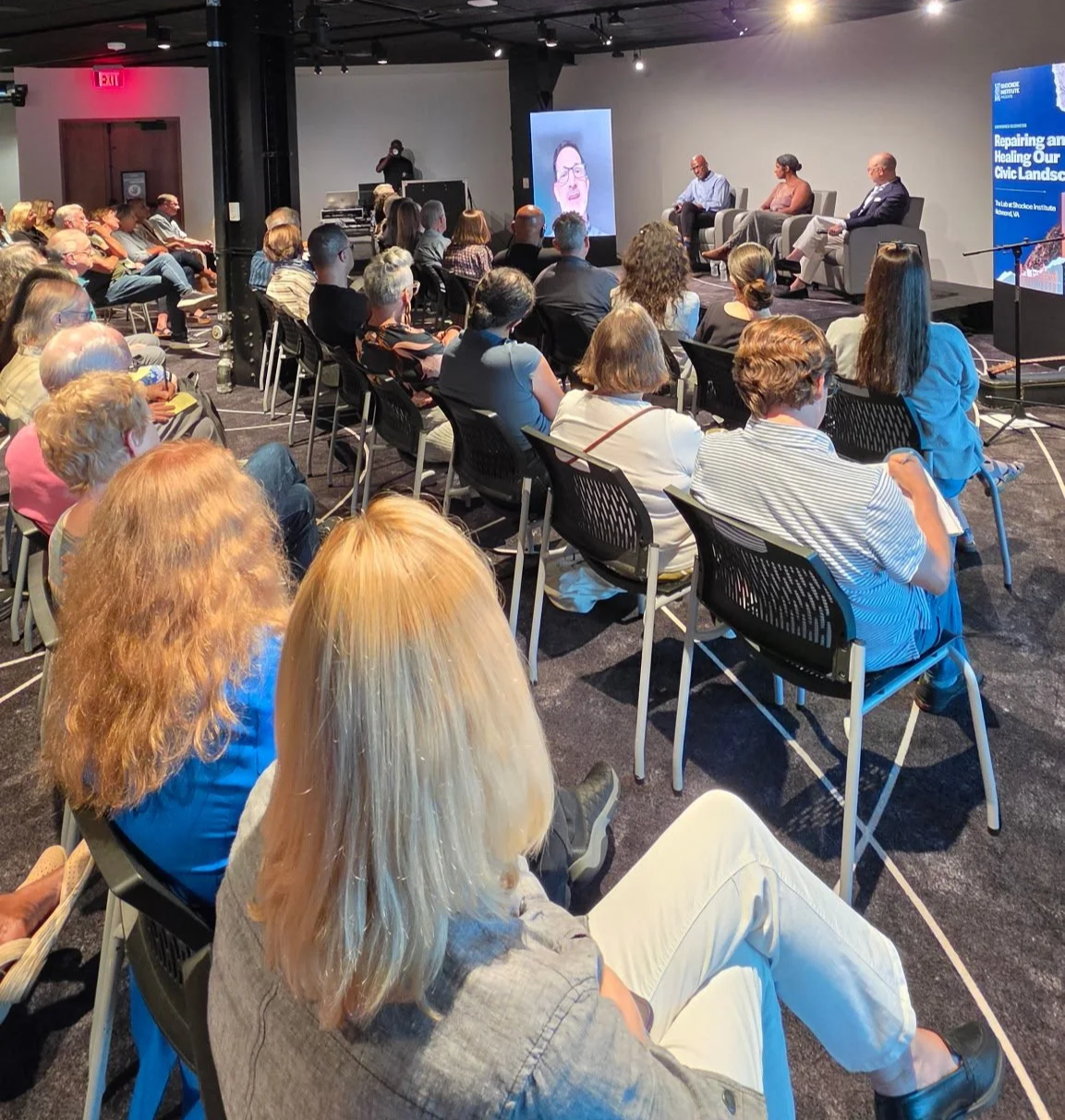
At several points in the evening, someone touched on the discouraging reality of the present—how we are inundated daily with devastating news, making the work of attempting to repair our civic square even more challenging. And yet, there we all were, absorbing the hopefulness of Leyla’s music and celebrating the ongoing renewal of hallow spaces and lost souls. It was as if we were given the chance to exhale, into a creative space of witnessing, lifting up truth, and expressing pent-up reverence for courageous Virginians who came before us and did so much with so little.
At the end of the evening, Marland asked the audience,
“How can we believe in a future we cannot see?”
I’m not sure what came to mind for others, but for me my mind went to Martin Luther King Jr.’s famous “arc of the moral universe,” which, he reminded us, “is long but bends toward justice.” Events like this redeem that faith, even in our troubled world, maybe more so because of it. Let’s keep having these sessions, learning from each other, and letting one discovery lead to another, one gravestone, legacy, story, and narrative revision at a time.
The views and opinions expressed in this post are those of the guest author and do not necessarily reflect the official positions or perspectives of the Shockoe Institute.
